|
The Power of Staying Invested: Time In The Market vs Time The Market
For KiwiSaver investors, no one wants to see their KiwiSaver balance decline. It is understandable that members can feel uneasy on "staying the course" as their balances shrink during the period of volatility. However, rushing for the switch of funds when the market goes down can actually slow long-term portfolio growth.
“Timing the market”
This is an ideal situation for investors to buy at lows and to sell at the highs. In fact, this can be incredibly difficult for investors to do so, and this could lead to unintended outcomes. Good timing on entries and exits might help avoid some losses, but it could also cause you to miss the market’s best days for value recovery.
US markets pushed higher recently, with the Nasdaq (+1.5%) and S&P 500 (+0.6%) hitting record highs. The strong market rebounding since early April has not only illustrated why staying the course matters through both ups and downs, but also showed how “time in the market” outperforms trying to “time the market”.
The Effect of Missing the Market’s Best Days In The Past 25 Year
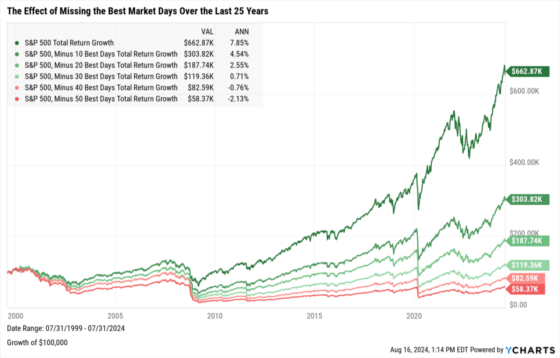
Based on S&P 500 data over 25 years (albeit this is to 2024), a NZD100,000 investment would have grown to around NZD663,000 if fully invested. Missing just the 10 best days could reduce the amount by more than a half. By missing the 30 best days could cut returns to a little more than the original value. If missing 40–50 of the strongest sessions, investor could get negative returns.
Importantly, many of these best days occur during periods of heightened volatility, and often alongside the worst days, making them extremely difficult to predict. It reinforces a simple but powerful point - "time in the market" is far more important than trying to "time the market". (refer to the Chart above)
|
 Patrick Wang